


 1
1

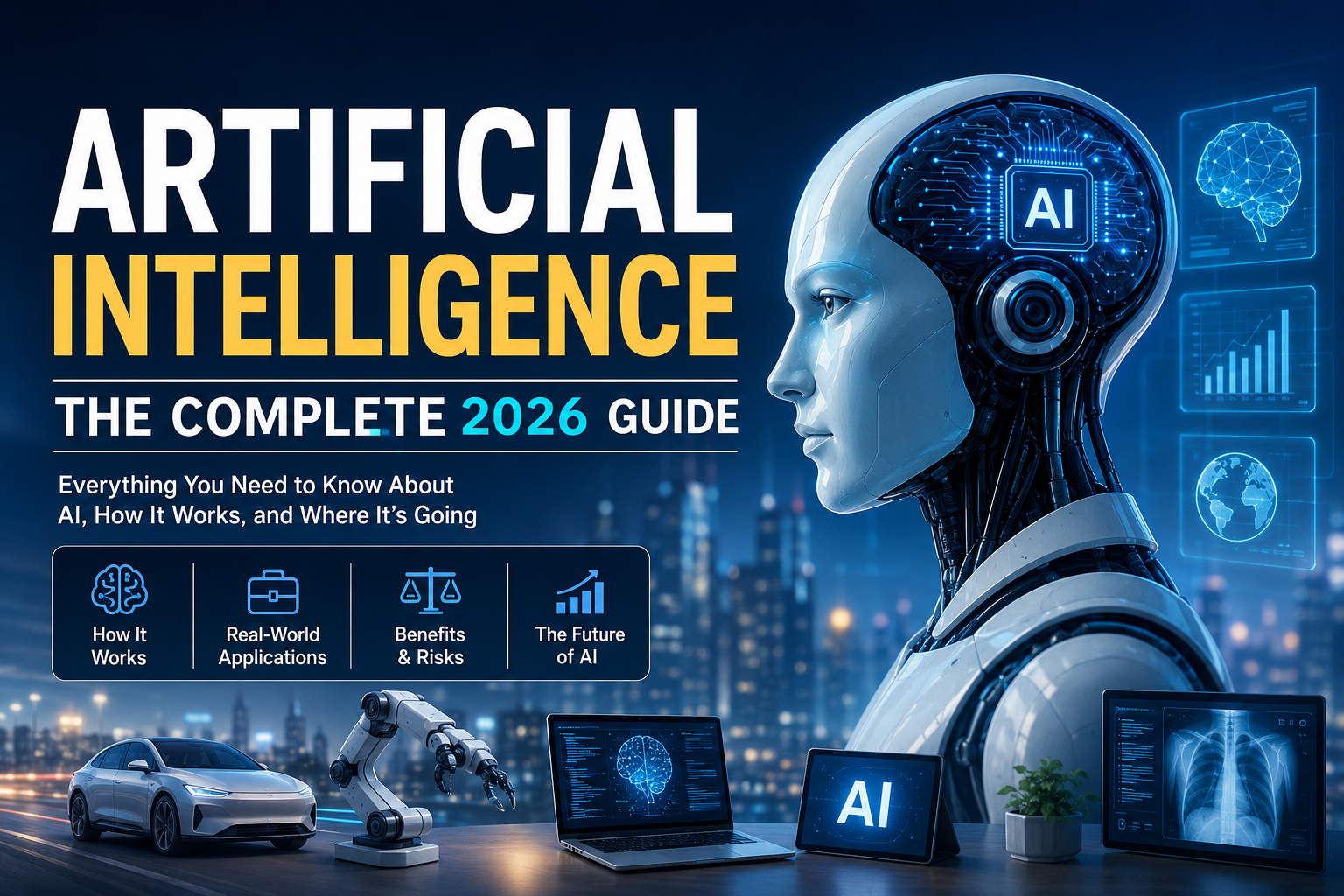
Artificial Intelligence: The Complete 2026 Guide
Artificial Intelligence: The Complete 2026 Guide
Twenty years ago, the idea of a computer writing your emails, diagnosing diseases, or driving your car sounded like science fiction. Today, it’s just Tuesday.
Artificial intelligence has moved from research labs into everyday life faster than almost any technology in history. It’s in your phone, your car, your workplace, and even your doctor’s office.
But what exactly is artificial intelligence, how does it work, and why does it matter so much right now? This guide breaks it all down in plain English — no computer science degree required.
Table of Contents:
- What Is Artificial Intelligence?
- How Does Artificial Intelligence Work?
- Types of Artificial Intelligence
- Real-World Applications of Artificial Intelligence
- Benefits and Risks of Artificial Intelligence
- The Future of Artificial Intelligence
- FAQs
- Conclusion
What Is Artificial Intelligence?
Artificial intelligence refers to computer systems designed to perform tasks that normally require human intelligence.
This includes things like:
- Understanding language
- Recognizing images
- Making decisions
- Solving problems
- Learning from experience
In simple terms, AI allows machines to “think” and improve on their own, rather than just following fixed instructions. It’s the technology behind voice assistants, recommendation engines, and self-driving cars.
Featured Snippet Answer: Artificial intelligence (AI) is a branch of computer science that enables machines to simulate human intelligence — including learning, reasoning, and problem-solving — using data and algorithms.
How Does Artificial Intelligence Work?
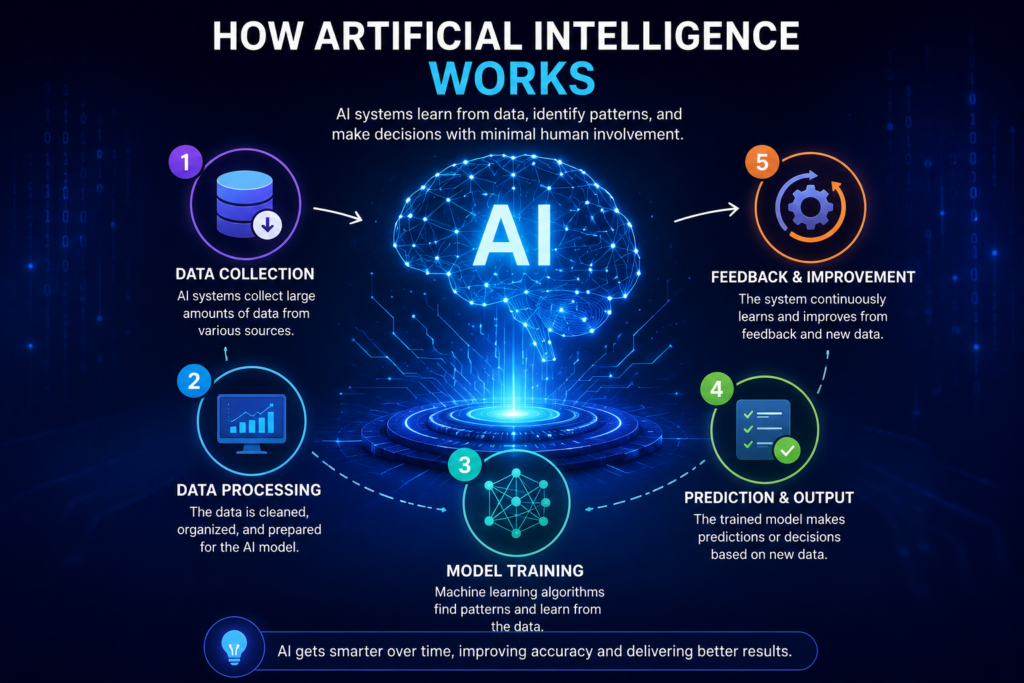
At its core, artificial intelligence works by processing huge amounts of data and identifying patterns within it.
1. Data Collection
AI systems are trained on massive datasets — text, images, numbers, or sound — depending on their purpose.
2. Machine Learning
Machine learning algorithms analyze this data to find patterns and relationships, gradually improving accuracy over time.
3. Neural Networks
Many modern AI systems use neural networks, which are loosely modeled on the human brain, allowing them to process complex information like images and language.
4. Output and Prediction
Once trained, the AI model can make predictions, generate content, or take actions based on new data it receives.
Types of AI:
Not all AI is created equal. Here are the main categories you’ll come across:
By Capability
- Narrow AI (Weak AI) — designed for a specific task, like spam filtering or facial recognition. This is the most common type today.
- General AI (Strong AI) — hypothetical AI with human-level intelligence across any task. Still theoretical.
- Superintelligent AI — a future concept where AI surpasses human intelligence entirely.
By Function
- Reactive Machines — respond to specific inputs without memory (e.g., chess-playing AI)
- Limited Memory AI — uses past data to inform decisions (e.g., self-driving cars)
- Generative AI — creates new content like text, images, and music (e.g., ChatGPT, Midjourney)
Real-World Applications of AI:
Artificial intelligence isn’t just theoretical — it’s already reshaping major industries.
Healthcare
- Diagnosing diseases from medical scans
- Predicting patient risks
- Accelerating drug discovery
Business and Finance
- Fraud detection in banking
- Automated customer service chatbots
- Predictive analytics for sales and marketing
Everyday Life
- Voice assistants like Siri and Alexa
- Personalized recommendations on Netflix and Spotify
- Navigation apps that predict traffic in real time
Transportation
- Self-driving vehicle systems
- Route optimization for delivery services
- Predictive vehicle maintenance
Benefits and Risks of AI:
Benefits
- Increased efficiency — automates repetitive and time-consuming tasks
- Better decision-making — analyzes data faster and more accurately than humans
- 24/7 availability — AI systems don’t need breaks or sleep
- Cost savings — reduces operational expenses across industries
- Innovation — enables breakthroughs in medicine, science, and technology
Risks
- Job displacement — automation may replace certain roles
- Bias in algorithms — AI can reflect biases present in training data
- Privacy concerns — large-scale data collection raises security questions
- Over-reliance — excessive dependence on AI may reduce human critical thinking
Pro Tip: Responsible AI use means pairing automation with human oversight — especially in high-stakes areas like healthcare, finance, and hiring.
The Future of AI:
Artificial intelligence is expected to become even more integrated into daily life in the coming years. Experts point to several key trends:
- More powerful generative AI for content, code, and design
- AI-powered scientific research, including drug discovery and climate modeling
- Greater regulation as governments address ethical and safety concerns
- Increased personalization across shopping, healthcare, and education
- Collaboration between humans and AI, rather than full automation
Rather than replacing humans entirely, most experts believe AI will act as a powerful assistant — enhancing human capability rather than eliminating it.
Frequently Asked Questions:
1. What is ai in simple terms?
Artificial intelligence is technology that allows computers to perform tasks that normally require human thinking, such as recognizing speech, making decisions, or solving problems.
2. What are the main types of ai?
The main types are Narrow AI (task-specific), General AI (human-level intelligence, still theoretical), and Superintelligent AI (a hypothetical future stage beyond human intelligence).
3. Is artificial intelligence the same as machine learning?
No. Machine learning is a subset of artificial intelligence — it’s one of the methods used to achieve AI by allowing systems to learn from data rather than being explicitly programmed.
4. How is artificial intelligence used in everyday life?
AI powers voice assistants, streaming recommendations, navigation apps, spam filters, and even the autocorrect feature on your phone.
5. Is artificial intelligence dangerous?
AI itself isn’t inherently dangerous, but risks like algorithmic bias, privacy concerns, and job displacement require careful regulation and responsible development.
Conclusion
Artificial intelligence has evolved from a futuristic concept into a technology that touches nearly every part of modern life — from healthcare and finance to entertainment and transportation.
Understanding how AI works, its benefits, and its risks isn’t just for tech experts anymore — it’s essential knowledge for anyone navigating today’s digital world.
Want to stay ahead of the curve? Explore more AI guides on our blog and discover how this technology can work for you, not against you.
One thought on “Artificial Intelligence: The Complete 2026 Guide”