



 1
1


15 Proven Test Taking Strategies That Boost Scores:
You studied for hours. You know the material. But the second the test lands on your desk, your mind goes blank and the clock feels like it’s speeding up.
Sound familiar? You’re not alone — and the problem often isn’t what you know. It’s how you take the test itself.
The right test taking strategies can be the difference between a good grade and a great one, even when your preparation level is exactly the same.
This guide breaks down proven techniques for before, during, and after the exam — so you can walk in confident and walk out with the score you actually deserve.
Table of Contents
Why Test Taking Strategy Matters:
Knowing the material is only half the battle. How you approach the test itself — your pacing, question order, and mindset — has a real impact on your final score.
Strong test taking strategies help you:
- Avoid running out of time on easy questions
- Reduce careless mistakes from rushing or misreading
- Manage anxiety so it doesn’t cloud your thinking
- Make smarter guesses when you’re unsure of an answer
Featured Snippet Answer: Effective test taking strategies include reading instructions carefully, answering easy questions first, managing your time per section, eliminating wrong answers before guessing, and reviewing your work before submitting.
Even strong students can underperform without a plan — which is exactly why test strategy deserves as much attention as content review.
Test Taking Strategies Before the Exam:
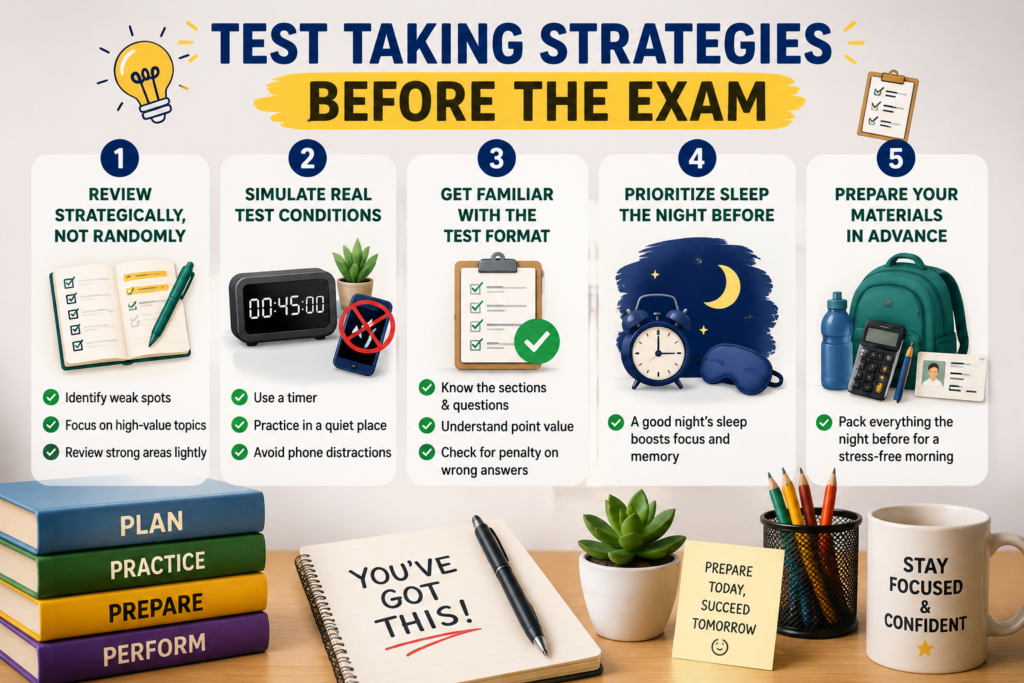
1. Review Strategically, Not Randomly:
In the days leading up to the test, focus review time on your weakest areas rather than rereading everything equally.
- Use practice tests to identify weak spots
- Prioritize high-value topics likely to appear frequently
- Do a light review of strong areas just to stay sharp
2. Simulate Real Test Conditions:
Practicing under realistic conditions builds both skill and confidence.
- Use a timer during practice tests
- Practice in a quiet space, distraction-free
- Avoid checking your phone mid-practice, just like on test day
3. Get Familiar With the Test Format:
Understanding the structure removes a major source of anxiety.
- Know how many sections and questions to expect
- Understand the point value of each section
- Check whether there’s a penalty for wrong answers
4. Prioritize Sleep the Night Before:
Sleep directly affects memory recall and focus. Cramming late into the night often does more harm than good — a well-rested brain outperforms a sleep-deprived one, even with slightly less review.
5. Prepare Your Materials in Advance:
Lay out everything you’ll need — pencils, calculator, ID, water bottle — the night before, so test-day morning stays calm and rush-free.
Test Taking Strategies During the Exam:
6. Read Instructions Carefully:
It sounds obvious, but rushing through instructions is one of the most common causes of lost points. Take 30 seconds to read carefully before starting.
7. Scan the Whole Test First:
Before diving in, quickly skim the entire test to:
- Gauge the difficulty and length of each section
- Identify easy questions you can answer quickly
- Plan roughly how much time to spend per section
8. Answer Easy Questions First:
Skipping tough questions on your first pass and returning to them later helps you:
- Bank points quickly and build confidence
- Avoid getting stuck and losing time on one question
- Ensure you don’t run out of time before reaching easier questions later in the test
9. Manage Your Time by Section:
Divide your available time based on section length and point value, and check your progress periodically to stay on pace.
Effective time management can also improve your overall productivity. For more practical techniques, check out our guide to 15 Productivity Tips That Actually Work.
Example approach for a 60-minute test:
- Section 1 (20 questions): 20 minutes
- Section 2 (15 questions): 20 minutes
- Section 3 (essay): 20 minutes
10. Flag and Move On:
If a question is taking too long, mark it and move forward. Coming back with fresh eyes later often makes the answer clearer.
Strategies for Different Question Types:
Multiple Choice Questions:
- Read all answer choices before selecting one
- Eliminate obviously wrong answers first to narrow your options
- Watch for qualifier words like “always,” “never,” or “except”
- If unsure, make an educated guess rather than leaving it blank (unless there’s a penalty for wrong answers)
Essay and Short Answer Questions:
- Quickly outline your main points before writing
- Answer the actual question being asked, not a related topic you know better
- Leave a few minutes at the end to reread and revise your response
Math and Problem-Solving Questions:
- Show your work, even if not required — it helps catch errors
- Double-check your final answer against the original question
- Use estimation to sanity-check whether your answer seems reasonable
For additional multiple-choice test-taking guidance, see College Board’s Test-Taking Tips
Managing Test Anxiety:
Anxiety can undo even the best preparation, so managing it is a core part of any effective test strategy.
Before the test:
- Practice deep breathing or short relaxation exercises
- Avoid last-minute cramming, which often increases stress
- Arrive early to avoid a rushed, anxious start
During the test:
- If you feel overwhelmed, pause and take 3 slow, deep breaths
- Refocus on the question in front of you, not the whole test
- Remind yourself that skipping one hard question is normal, not a failure
Pro Tip: A short pause to reset your breathing often costs less time than the mistakes made while rushing through a panic spiral.
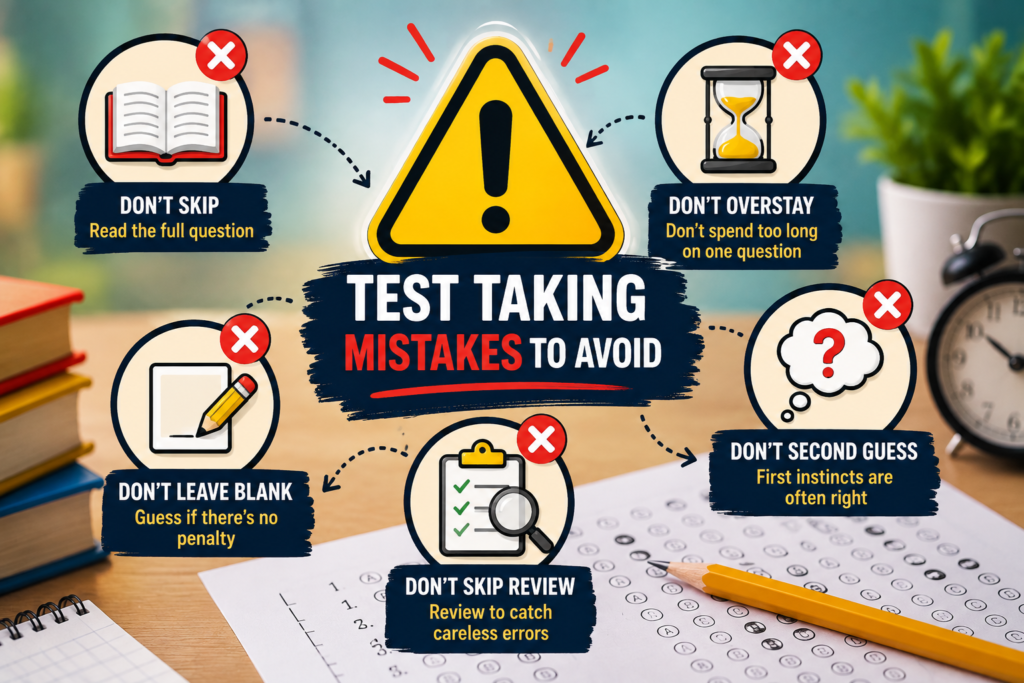
Common Test Taking Mistakes to Avoid:
Even well-prepared students lose points to avoidable errors. Watch out for:
- Not reading the full question before answering
- Spending too long on one question, leaving less time for others
- Second-guessing correct first instincts without new information
- Leaving answers blank when guessing carries no penalty
- Skipping the review step at the end, missing careless errors
Frequently Asked Questions:
1. What are the best test taking strategies for multiple choice tests?
Read all answer choices first, eliminate clearly wrong options, watch for absolute qualifier words, and make an educated guess rather than leaving a question blank when there’s no penalty.
2. How can I manage my time better during a test?
Scan the entire test first, allocate time per section based on length and point value, and skip difficult questions temporarily to return to them later.
3. What should I do if I don’t know an answer?
Eliminate any obviously incorrect choices, look for context clues in other questions, and make your best educated guess rather than leaving it blank when there’s no penalty for guessing.
4. How do I reduce test anxiety before an exam?
Practice under realistic timed conditions, prioritize sleep the night before, and use deep breathing techniques if anxiety spikes during the test itself.
5. Should I change my answer if I’m unsure after reviewing?
Only change an answer if you find clear evidence you made a mistake — research shows first instincts are often correct, so avoid changing answers based on doubt alone.
Conclusion:
The right test taking strategies won’t replace solid preparation, but they can absolutely help you make the most of what you already know.
From smart time management to handling anxiety in the moment, small strategic changes can add up to a meaningfully better score.
Ready to put these strategies into practice? Pick two or three techniques from this guide to try on your next test, and build from there.
One thought on “15 Proven Test Taking Strategies That Boost Scores:”